Wednesday, 17 May 2006

What is SFIA anyway?

I've mentioned SFIA in a previous entry and thought it would be helpful if I gave a quick overview of what it is, and why we should care about it.

In July 2003, the BCS, the IEE, and IMIS formed the SFIA (Skills for the Information Age) foundation. The primary goal of this was to create a high level skills competency framework for IT professionals, much like those that already existed in other industries, as well as a standard language for talking about IT skills. Indeed, it grew in part from the BCS's ISM (Industry Standard Model) which was subsequently modified in accordance with SFIA and rebranded as SFIA+. It is SFIA+ that forms the basis of the BCS professional development product offerings. But I digress, back to the framework itself.

SFIA version 3 is at first sight a relatively simple two-dimensional matrix. There are 7 responsibility levels across the top (1 being the lowest) and 6 main categories of work down the left as follows:

Strategy and Planning
Development
Business Change
Service Provision
Procurement and management support
Ancillary Skills

Each main category incorporates sub-categories and skills. It should be noted that the placement of skills within categories can be argued (and has been). When using the matrix to assess your skills as an IT professional it is important to indicate where you have a competency regardless of which category it falls under; the categories are really a convenient matrix navigation aid and not intended to be limiting. For example, if your main role at work is that of network support this falls within the Service Provision category. However, you also have project management experience which falls under Business Change. Therefore you have skills in both areas, and that is okay. In today's environment I'd go so far as to say cultivating skills in the business change arena is to be encouraged!

Okay, so far it seems sensible enough, but how do you know if you are selecting the 'right' skill and how do you decide which level to record against it? That's where the skills definitions reference document comes in. Let's look at the example of Network support within User support on page 29.
Network support (NTAS)
The provision of network maintenance and support services. Support may be provided both to users of the systems and to service delivery functions. Support typically takes the form of investigating and resolving problems and providing information about the systems. It may also include monitoring their performance. Problems may be resolved by providing advice or training to users about the network’s functionality, correct operation or constraints, by devising work-arounds, correcting faults, or making general or site-specific modifications.

Level 2 Assists in investigation and resolution of network problems. Assists with specified maintenance procedures.

Level 3 Identifies and resolves network problems following agreed procedures. Uses network management software and tools to collect agreed performance statistics. Carries out agreed network maintenance tasks.

Level 4 Maintains the network support process and checks that all requests for support are dealt with according to agreed procedures. Uses network management software and tools to investigate problems, collect performance statistics and create reports.

Level 5 Drafts and maintains procedures and documentation for network support. Ensures that all requests for support are dealt with according to set standards and procedures.

From this we can decide whether it is the most appropriate skill and furthermore, the appropriate level with which to assess ourselves against.

For IT professionals, this framework is an excellent tool to help identify your strengths, weaknesses, and areas for improvement, i.e. peform a gap analysis. However, I'd go a step further and say that IT professionals should join the British Computer Society and make use of the Career Developer facility using SFIA+ which has much more depth. More on that in another blog entry.

For employers, once your staff have completed an assessment you then have an accurate skills database which is a plus point for auditors and Investors in People assessments! However, far more use is the fact that should someone leave the organisation, you now have the information at your fingertips to decide which of their skills you wish to hire back in, or make the decision that actually you need someone with another skill set.

Long-term I see the terminology used in SFIA forming the basis of job adverts. As it becomes the recognised standard for the industry by the IT professionals themselves; recruitment can be streamlined as candidates will have a clearer idea of what the job entails before making an application, and employers will have a clearer idea of what they are actually looking for. A definite improvement over the current situation.

Friday, 5 May 2006

Chugg chugg!

Hello again. I'm in the new house but unfortunately I'm waiting on my broadband installation so I've fallen back onto, dare I say it, dial-up. It just shows what an internet addict I ashould reduce myself to such drastic measures !

I've got quite a lot on at the moment and also going on holiday so I'll try and get one decent post in per week until I'm back on broadband.

One thing to highlight quickly for and ITIL people out there is the opportunity to attend a teleseminar with Robin Yearsley and Randy Steinberg on 10th May. If you're interested do sign-up now as places are limited.

Wednesday, 26 April 2006

Into the frying pan - My first 'major' project - part 3

A couple of weeks into the project I was told by the board that I was to use PrInCE2 Lite methodology to manage the project - and they wanted a PID. PrInCE2? A PID? What's are they when they're at home? I made haste to the office of our resident qualified practitioner who thankfully took pity on my ignorance and walked me towards the light.

A few hours later I emerged with a seriously high-level overview of Prince 2 (which I now knew was yet another wonderful acronym - PRojects IN Controlled Environments) and some standard templates all prepared to write the PID (i.e. Project Initiation Document a.k.a. PDS - Project Definition Statement).

When I say seriously high level I mean that I came out knowing what SU, IP, DP, CS, MP, SB, CP, and PL stood for and a rough idea of what was needed in each - and I mean rough! For those of you not familiar with Prince 2 it is pretty hefty and not something that can be learnt just like that. I am not qualified and rather keen to attend a course so I can get my head around it all!

Anyhow, once I delved into the template for the Project Initiation Document I cringed. There were yet more terms I didn't know, and sections that needed answers that I didn't yet have.

Thankfully you need not scour the web for such definitions as I have 2 links to recommend that will make quite the difference. The first is the Glossary of Terms (9 page PDF for download). The second is not exclusively Prince 2 but a truly excellent resource - Wideman Comparative Glossary of Project Management Terms v3.1.

In the next part of this saga, I will talk about the stakeholders and how I got their input (and in some cases how I failed to do so!).

The ITIL Imp goes into hiding?

Well not really, but it's unlikely that I will be posting for a week or so as I'm in the process of moving house and I'm sure most of you know how time consuming that can be. I suddenly realise not just how many books I own, but worse, how many of those I still haven't made the time to read! So, until next time, this is the ITIL Imp signing off!

Wednesday, 19 April 2006

Into the frying pan - My first 'major' project - part 2

In part 1 I talked about how I got involved in the rather interesting world of Project Management. In part 2 (and those that follow) I'm going to talk about some of the highs and lows along the way, my learning points, etc. So, onward!

The first thing we did was assemble a project team. This was quite a strange affair as, looking back, I think I had very little to do with the make up of it; rather, it landed in my lap. The first thing that happened was the board appointed one of their group to be the project executive (sponsor). As it happened he was from one of the other council's in the partnership. We met one afternoon and had a really good chat about ourselves and backgrounds, what we were expected to do, the kind of deliverables we wanted from it, etc. We seemed to see eye-to-eye on things and were keen that it needed to be a managed as short sharp project.

Then came the rest of the team. As one would expect we involved a Help Desk operator from each council - except the one I was from. Having started at this council in the role and continuing to oversee it, it was considered I had the required knowledge. We did include a member of technical support from one of the other councils to represent that viewpoint but that is where the team stopped growing. Although we had opportunities to invite a representative from a separate partnership technical sub-group; in hindsight it would have been better if they were included as part of the project team itself. So, we've got 2 project team members from each council except the one I work for who had, well - me.

Our first project meeting felt quite exciting and there was a very positive vibe. None of us knew one another and there was a lot of work to do to become a team, but still, we were all curious about how this partnership would work and here we were, starting to actually work together. Once we got the introductions out of the way and some understanding of one another's viewpoints we delved straight into figuring out just what we were expected to deliver.

We figured that a good place to start would be defining our ideal help desk operation and an appraisal of the existing call logging tools in use at each council (Heat, Sunrise, and Touchpaper). This is where I found questionnaires quite helpful to both elicit the information and to compile and compare the results afterwards.

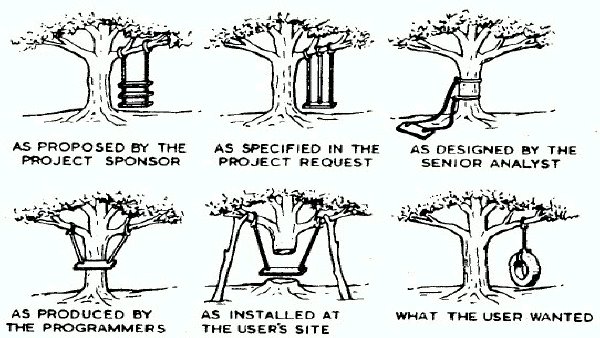
And with that I leave you this cartoon that I believe is rather appropriate to the position we found ourselves in... and something you want to avoid at all costs (Found on http://www.grin.com/en/fulltext/ine/23156.html ) !

Friday, 14 April 2006

ITIL Foundation Certificate - Tips to pass the exam

One of the frequent questions I come across is 'how do I pass the Foundation exam?' The ITIL Foundation Certificate is the only ITIL examination that can be taken through self-study and public examination. I personally recommend a course with an accredited training provider as you get the benefit of networking with others and can glean some useful insights into how ITIL works in the real world - which you can't get from the books. Also, decent trainers have prior experience with the examinations and can test you in mock examination conditions using official sample papers. Furthermore, they can advise you of the key things that really must be memorised, and the things that you need to understand (though not necessarily know by rote). I took my ISEB Foundation Certificate through Fox IT in the UK and was trained by Gerry McLaughlin and would highly recommend them.

There are two examining boards for ITIL certifications, the ISEB and EXIN. Whichever board you choose, ensure you learn the content of their syllabus.
Download EXIN Syllabus (PDF)
Download the ISEB Syllabus (PDF)


My advice would be to ensure you know:
- which processes belong to service delivery and which to service support
- the key activities that make up each process
- who is responsible for various activities (in terms of process ownership)
- the acronyms and terminology used in each process as well as key phrases that may indicate which process the question is about (Glossary of terms link)
- the inter-relations between processes
- the benefits that can be realised from each process

Ensure you remember that they are testing you on ITIL as it is in the books, NOT on what you do (or don't do!) in your current organisation.

In terms of the examination itself which is 40 multiple choice questions (ISEB), read the question - ensure you understand it then look at all the answers. If you don't know the answer straight away, work with a process of elimination. Quite often with these there is one really wrong answer, and with the other three there is one that is 'more correct' than the others. So be careful not to be caught out. Read EVERY word of an answer. Overlooking the word 'NOT' can be the difference between a correct or wrong answer!

If you know the material, you'll find the exam is less exerting than a walk in the park. If you don't, you may struggle - so make sure you do ;)

A couple of sample questions from ISEB sample paper 3 2003

10. Which of the following is NOT a technique usually associated with Availabilty Management?
A. Auto error detection
B. Duplexing
C. Analysing Data
D. Queuing theory

16. Which of the following best describes why an SLA should contain definitions of terms?
A. To ensure that anywhere there is a measurement required within the SLA then it is realistically measurable
B. To ensure that both the customer and IT can unambiguously understand the terms in the SLA
C. To make sure that all clauses in the SLA make sense
D. To ensure that the customer's understanding of a particular term is the one meant in the SLA.

Finally, some links that may be of use:

Dr Itil used to have a foundation success blog with tips up but it seems to have died. There is a little entry on his old blog.

You can try some ITIL exam practice.

ITIL essentials study guide (not used myself so unable to confirm accuracy but Dr ITIL linked it awhile back so I'd expect it to be okay).

ITIL reference guide on Robert Perrine's site. Well worth browsing the rest of his site under the ITIL section as he includes slides from his study lessons.

Good luck, see you on the other side!

P.S. Answer to No. 10 = D and No. 16 = B

Tuesday, 11 April 2006

What does it mean to be a Service Delivery Manager?

Over the past 2 years I've been thinking that we could really use a Service Delivery Manager where I work. Curiously enough, it turns out that the new Technical Operations Manager thinks so as well and sees the role as fundamental to contributing to the overall strategy for service provision. So he asked me to write a paper outlining my strategy for service provision over the coming years. Great, except that as the reporting lines have not yet been resolved my line managers are reluctant to let me spend any time researching and writing the report as it will take away from the day job. A fair point, but should I really be doing this in my own time and not being paid for it? Part of me says 'no' - it is for work to benefit therefore I should continue to maintain my work/life balance. Another part says that it is a missed opportunity for me personally if I do not.

Anyhow... all of this has me wondering 'What does it mean to be a Service Delivery Manager?' I believe it is more than service level management as defined by ITIL, and it should include service introduction management. I'd like to write a job description and person specification, so, as a starting point, started trawling job adverts only to find there is a wide range of views. Over the next week or so I'm throwing the question open to the rest of you. I'll write up my answer in a couple of weeks incorporating your views, and although it may not be definitive - hopefully it will be a reasonable answer to an important question.